
Brick Pattern: 10 Popular Designs for Walls, Patios and Gardens
Choosing the right brick pattern can change the appearance of a house, garden path, patio or driveway without changing the bricks themselves. The arrangement of each brick, the direction of the joints and the colour of the mortar all influence the finished result. Some layouts create a traditional European appearance, while others suit contemporary homes and minimalist gardens.
The best option depends on where the bricks will be used, whether the surface needs to carry weight, and how much maintenance it will require. A wall also has different structural requirements from a paved walkway. Understanding these differences helps you select a design that looks attractive and performs well over time.
This guide explains ten popular brick layouts, their advantages, suitable applications and practical considerations for homeowners, landlords and renovation projects across Europe.
What Is a Brick Pattern?
A brick pattern is the arrangement of individual bricks and their joints across a wall, floor or paved surface. It determines the visual rhythm of the finished area and, in traditional masonry, may also contribute to the way bricks interlock.
The term can describe structural brick bonds, decorative wall arrangements and paving layouts. These applications should not be confused. A pattern suitable for a garden path may not provide the bonding needed for a load-bearing wall.
Three elements influence the final appearance:
-
Brick orientation: Bricks can be laid lengthways, end-on or at an angle.
-
Joint arrangement: Vertical joints may be staggered or aligned.
-
Colour and texture: Brick shades, surface finishes and mortar colours create different visual effects.
According to Wienerberger, brick bonding influences both the visual character and the construction of a building. The appropriate arrangement depends on the intended application and the wall design.
10 Popular Brick Pattern Designs
1. Running Bond Pattern

Running bond, also called stretcher bond in wall construction, is one of the most familiar arrangements. Each brick is laid lengthways, with its vertical joints offset from those in the course below.
This creates long horizontal lines and a clean, orderly appearance. It works well on contemporary house façades, garden walls, brick slips and many paving projects.
Best for: Modern homes, exterior walls, paths and simple patio layouts.
Advantages: The arrangement is straightforward, visually balanced and generally economical to install.
Considerations: Traditional stretcher bond is common in modern cavity-wall construction, but the structural performance depends on the complete wall assembly, not the visible pattern alone.
2. Stack Bond Pattern

Stack bond places bricks directly above one another, aligning both horizontal and vertical joints into a regular grid. The result resembles a geometric tiled surface.
This brick pattern suits contemporary architecture, feature walls and decorative panels where clean lines are more important than a traditional appearance.
Best for: Interior feature walls, architectural façades and decorative brickwork.
Advantages: It creates a precise, minimalist appearance and highlights the shape and colour of individual bricks.
Considerations: Because the joints align vertically, stack bond does not provide the same natural interlocking as conventional staggered bonds. Structural walls using this arrangement may require engineered reinforcement or another suitable support system. Do not assume it is appropriate for load-bearing masonry without professional design.
3. Flemish Bond Pattern

Flemish bond alternates between the long face and the short end of bricks within each course. The short ends, known as headers, appear between the longer stretchers, producing a distinctive repeating design.
This arrangement is associated with many traditional British and European buildings. It can give a façade visual depth and a sense of craftsmanship.
Best for: Period-style houses, heritage renovations and traditional boundary walls.
Advantages: The alternating faces create an attractive, detailed appearance without relying on different brick colours.
Considerations: Brick selection, cutting, labour and corner detailing can increase installation complexity. On modern cavity walls, decorative headers must be detailed correctly so they do not create unintended bridges across the cavity.
4. English Bond Pattern

English bond uses alternating courses: one course displays the long faces of the bricks, while the next displays their short ends.
This traditional arrangement is recognised for its strong, regular appearance. In suitably designed solid masonry, its interlocking arrangement can provide effective bonding through the wall thickness.
Best for: Traditional masonry, restoration projects and suitable solid boundary walls.
Advantages: It creates a pronounced horizontal rhythm and can provide effective structural bonding when correctly constructed.
Considerations: It generally requires more careful setting out than a basic running bond. Its suitability depends on wall thickness, loading, materials and construction details.
English bond and Flemish bond may look similar from a distance, but their arrangement differs within each course.
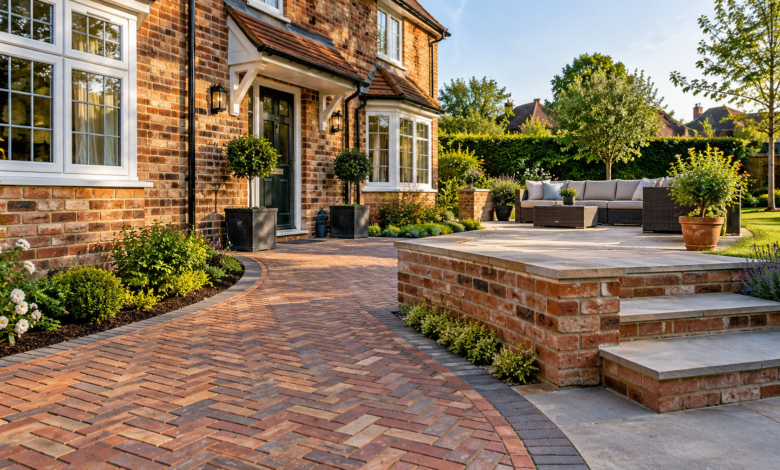
5. Herringbone Pattern

Herringbone arranges rectangular bricks in alternating directions to create a zigzag design. Bricks may be positioned at 45-degree or 90-degree angles, depending on the layout.
It is especially popular for patios, driveways, courtyards and garden paths. The interlocking layout can also help distribute movement across suitable paving installations.
Best for: Driveways, outdoor seating areas, garden paths and entrances.
Advantages: It provides a distinctive appearance and can perform well under traffic when installed over an appropriately designed paving base.
Considerations: Accurate cutting and careful edge detailing are important. A poorly prepared foundation can cause settlement regardless of the chosen layout.
6. Basketweave Pattern

Basketweave uses pairs or groups of bricks arranged alternately in horizontal and vertical directions. The repeating units create a woven appearance similar to the crossing strands of a basket.
This decorative arrangement suits traditional gardens and smaller paved areas where a detailed surface can become a design feature.
Best for: Garden paths, courtyard patios and decorative outdoor spaces.
Advantages: The pattern adds visual interest without requiring several brick colours.
Considerations: The layout needs careful planning around edges and drainage features. For frequently used outdoor areas, choose bricks designed for paving rather than ordinary wall bricks.
7. Header Bond Pattern

Header bond places the short ends of the bricks towards the visible face. Successive courses are arranged with appropriate offsets to create a regular pattern.
Because the brick ends face outward, the surface has a tighter visual rhythm than a wall made predominantly from stretchers.
Best for: Traditional masonry, curved brickwork and selected heritage details.
Advantages: It produces a distinctive appearance and can suit certain curved structures when correctly designed.
Considerations: It may require more facing bricks and additional labour. A qualified bricklayer should determine whether it suits the wall’s construction and structural requirements.
8. Soldier Bond Pattern

Soldier bond places bricks upright, with their long faces visible vertically. It is often used as a decorative course rather than across an entire wall.
The upright arrangement can frame windows, doors, garden entrances and other architectural features.
Best for: Window surrounds, door headers, decorative borders and façade accents.
Advantages: It creates a strong vertical emphasis and contrasts nicely with horizontal brickwork.
Considerations: The supporting lintel, movement joints and fixing details must be appropriate for the particular installation. Decorative appearance should never replace proper structural support.
9. Monk Bond Pattern

Monk bond is a traditional arrangement that generally uses two stretchers between headers within each course. Variations exist, so the precise appearance depends on the brick dimensions and setting-out method.
The result combines horizontal lines with occasional short brick faces, producing a less uniform appearance than running bond.
Best for: Traditional houses, garden walls and sympathetic heritage extensions.
Advantages: It provides a traditional character and a repeating rhythm that can complement older brick buildings.
Considerations: Correct spacing and corner details require experience. When extending an older property, identify the existing arrangement before choosing a matching design.
10. Wild Bond Pattern

Wild bond uses a controlled mixture of brick offsets to create a less regular appearance. Although it looks informal, the layout still requires planning so joints, corners and brick dimensions work together.
This approach can complement rustic homes, reclaimed bricks and garden walls with varied colours or textures.
Best for: Rustic façades, garden features and selected decorative brickwork.
Advantages: It produces a relaxed, traditional appearance and can work well with reclaimed materials.
Considerations: Random placement should never mean random structural construction. The design must follow the requirements of the wall system, and unsuitable continuous joints should be avoided.
How to Choose the Right Brick Pattern
The best option depends on the intended use, architectural style, installation budget and technical requirements.
| Application | Suitable options | Main consideration |
|---|---|---|
| Modern house façade | Running bond, stack bond | Structural design and joint detailing |
| Traditional house | Flemish bond, English bond, monk bond | Matching existing masonry |
| Garden pathway | Running bond, herringbone | Drainage and stable foundations |
| Driveway | Herringbone, suitable running layouts | Vehicle loads and edge restraints |
| Patio | Basketweave, herringbone | Slip resistance and surface drainage |
| Window surrounds | Soldier bond | Lintels and support |
| Rustic garden wall | Wild bond, monk bond | Consistent workmanship |
Before ordering materials, consider the size and shape of the area, the brick dimensions, mortar joint width and the number of cuts required.
For a paving project, ask the installer to prepare a small sample layout. Seeing the bricks in their actual colour and arrangement can help you identify problems before work begins.
Brick Colour, Mortar and Installation Costs
The appearance of a finished wall depends on more than the layout. Red, brown, buff, grey and mixed-colour bricks can produce very different results using the same arrangement.
Mortar colour also matters. A contrasting mortar highlights individual bricks and joints, while a closer colour match produces a more uniform surface. Recessed or flush joints can change the appearance further.
Installation costs vary according to the country, local labour rates, brick type, wall dimensions and project complexity. Flemish, English and decorative arrangements may require more setting-out, cutting or specialist workmanship than simpler layouts.
For paving, the base preparation, drainage, edging and excavation may account for a substantial part of the overall project cost. Request itemised quotations rather than comparing prices based only on the cost per brick.
Maintenance and Common Installation Mistakes
A properly selected and installed brick surface can last for many years, but maintenance requirements depend on the material, climate and exposure.
For exterior walls, inspect mortar joints, cracks, loose bricks and areas where water collects. Address the source of persistent damp before applying coatings or sealants. Older buildings may need compatible lime-based mortar rather than modern cement-rich products.
For patios and paths, sweep away debris regularly and keep drainage channels clear. Remove moss carefully, especially in shaded or damp areas where surfaces may become slippery. Use cleaning products suitable for the specific brick and mortar.
Avoid these common mistakes:
-
Choosing a decorative wall bond without checking its structural suitability.
-
Using ordinary wall bricks for paving without confirming their durability.
-
Ignoring drainage and ground preparation.
-
Selecting a pattern without considering cuts and edge details.
-
Repointing historic masonry with an incompatible mortar.
-
Assuming a particular arrangement guarantees strength without considering the complete construction.
If you notice bulging walls, substantial cracking, loose masonry or movement around openings, seek advice from a qualified building professional rather than attempting a cosmetic repair.
Conclusion
The right brick pattern combines visual appeal with practical performance. Running bond offers simplicity, Flemish and English bonds provide traditional character, and herringbone creates a distinctive paving surface. Stack bond and soldier courses can add contemporary or architectural detail when correctly specified.
Before making a final decision, consider the building style, intended use, drainage, material suitability and installation requirements. For structural walls or vehicle-bearing paving, professional advice can help ensure that the finished project is both attractive and fit for purpose.
Frequently Asked Questions
What is the most popular brick pattern?
Running bond, also known as stretcher bond in wall construction, is widely used because it creates a simple, orderly appearance and suits many modern buildings.
Which brick pattern is best for a driveway?
Herringbone is a popular choice for brick driveways because its interlocking arrangement can perform well under vehicle traffic when the paving base, edging and materials are correctly specified.
Which brick pattern looks most modern?
Stack bond is a common choice for contemporary designs because its aligned joints create a clean geometric grid. Its structural limitations must be addressed in the wall design.
Is Flemish bond stronger than English bond?
English bond is traditionally regarded as stronger for suitably constructed solid masonry because its alternating courses provide effective bonding through the wall thickness. Actual performance depends on construction and design.
Can I use the same brick pattern indoors and outdoors?
Yes, visually similar layouts can be used in both settings, but the bricks must suit their application. Outdoor paving requires appropriate durability, slip resistance and a properly prepared base.
How do I calculate the number of bricks required?
Measure the area, calculate the coverage of the selected brick and joint dimensions, and add an allowance for cutting and breakage. The final quantity depends on the pattern, brick size and installation method.





One Comment