
Home Maintenance
How Often to Rotate Tires? A Practical Guide to Timing, Patterns and Tyre Wear
If you are wondering how often to rotate tires, the safest starting point is your vehicle manufacturer’s schedule. When no specific interval is provided, a common guideline is roughly every 8,000–10,000 km (about 5,000–6,000 miles), though some tire manufacturers recommend slightly different intervals. Michelin, for example, advises approximately 8,000–10,000 km for many passenger vehicles. Bridgestone says to follow the vehicle manufacturer or, if no recommendation is provided, rotate at about 8,000 km. The correct interval can vary by vehicle, tire design, drivetrain, and wear pattern.
How often to rotate tires?
Knowing how often to rotate tires starts with your car’s service schedule. The interval below is a useful general guide, not a substitute for the manufacturer’s instructions.
For many passenger cars, a practical starting point is every 8,000–10,000 km, but the owner’s manual should take priority. Some manufacturers specify a time-based interval, a mileage interval, or rotation at every service. If your car has unusual tire sizes, directional tires, a staggered wheel setup, or a four-wheel-drive system, the correct schedule and pattern may be different.
Why tire rotation matters
Tires wear because each wheel position has a different job. On a typical front-wheel-drive vehicle, the front axle handles propulsion, steering, and much of the braking. Rear-wheel-drive vehicles can place greater drive-related demand on the rear tires. This means one axle may wear noticeably faster than the other.
Rotation moves the tire according to an approved pattern. The goal is not to make worn tires new again; it is to prevent one pair from wearing significantly faster than the others. More even tread wear can help you get more consistent use from the set, provided the tires are otherwise suitable and maintained correctly.
Michelin also notes that uneven wear can be linked to issues such as incorrect wheel alignment, so don’t use rotation to hide an underlying mechanical problem.
Signs you should rotate your tires sooner
If you are unsure how often to rotate tires after noticing a wear pattern, arrange an inspection rather than simply moving the tires.
Look for:
- Noticeably different tread depth between front and rear tires.
- Uneven wear across the width of a tread.
- Faster wear on one side of a tire.
- Feathering, cupping or other irregular tread patterns.
- A vehicle that pulls to one side or feels different while driving.
- Vibration or unusual road noise, particularly if it is new.
Can every tire be rotated?
The answer also affects how often to rotate tires, because some tire and wheel combinations cannot follow a conventional pattern.
Directional tires have a specified rolling direction and must continue rotating in that direction. Michelin explains that these tires generally need a same-side front-to-rear rotation unless the tire is removed from the wheel and remounted in the opposite position.
Asymmetrical tires also have mounting requirements. The side marked “Outside” must remain on the outside of the wheel. Some cars use different tire sizes at the front and rear, known as a staggered setup. Those tires may not be interchangeable between axles.
Check your owner’s manual and the markings on the tire sidewall before changing positions. Do not copy a generic rotation diagram if your vehicle or tire configuration does not permit it.
How often to rotate tires with different drivetrains?
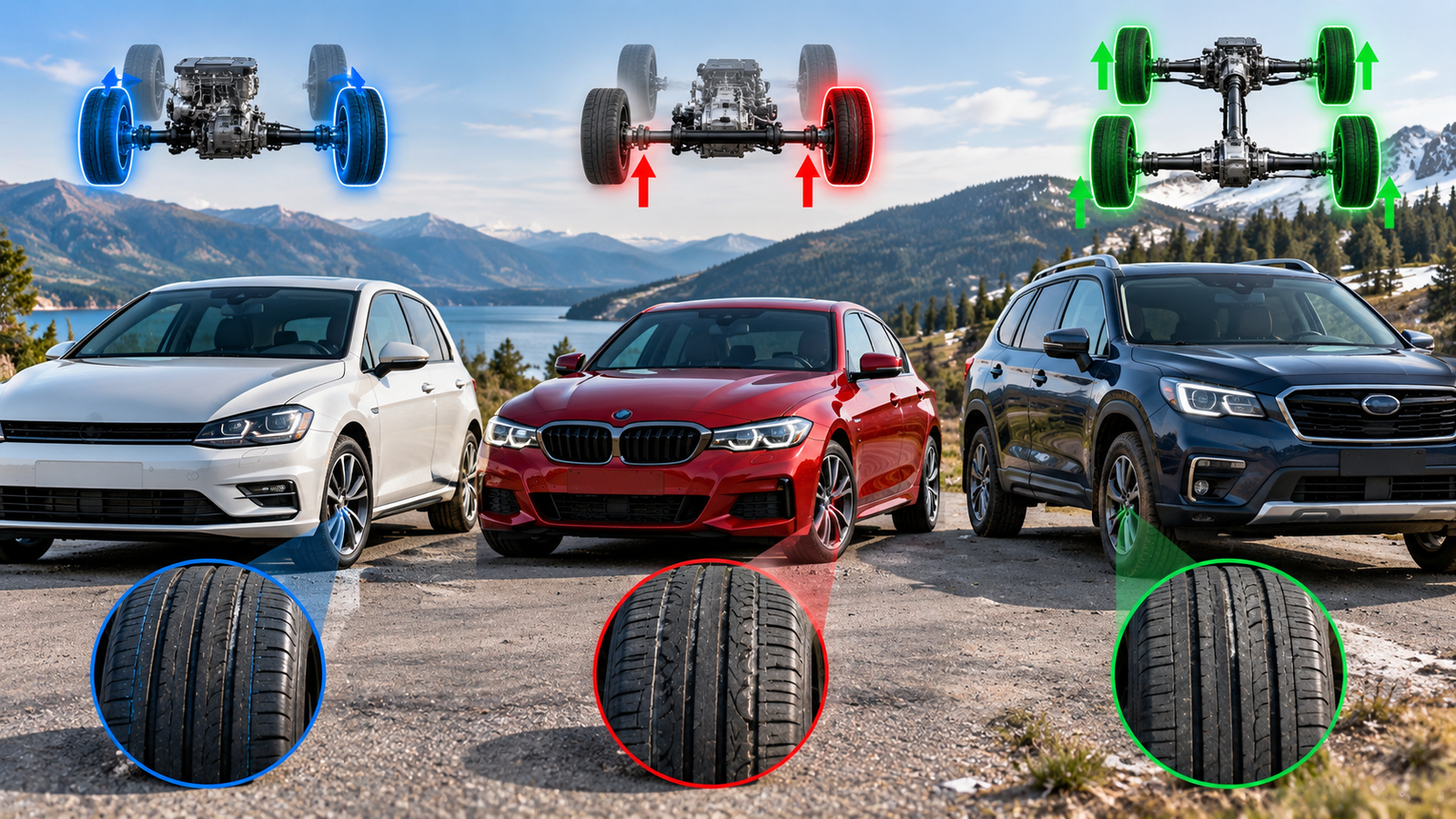
The drivetrain can influence how often to rotate tires, but it does not automatically determine a single rotation interval. That is why you should check the vehicle handbook rather than guess based on drivetrain type alone.
Front-wheel drive
Front tires commonly wear faster because they steer, brake, and transmit engine torque. If the manufacturer permits rotation, regular position changes can help balance wear between axles.
Rear-wheel drive
Rear tires handle the engine’s driving force, while the front tires handle steering and braking. The wear pattern can therefore differ from a front-wheel-drive car.
All-wheel drive and four-wheel drive
AWD and 4WD vehicles need particular attention because tire diameter and tread-depth differences can affect the drivetrain. Follow the vehicle manufacturer’s instructions closely. Some systems require tires to remain closely matched in circumference or wear.
For more insights, read our previous article: Soft Water System Repair
How to rotate tires safely
If you are researching how often to rotate tires, safety matters as much as the mileage interval.
For routine service, having a qualified tire professional perform the rotation is often the simplest option, particularly if the car has directional tires, staggered sizes, TPMS sensors, or an unusual drivetrain.
If you are checking the planned rotation, make sure the correct pattern is specified for your exact vehicle and tire configuration. After rotation, check and adjust tire pressures to the vehicle manufacturer’s recommended pressures for the new wheel positions. Bridgestone specifically advises checking each tire’s pressure after rotation.
A temporary-use spare should not automatically be included in a rotation. A matching full-size spare may be treated differently, but follow the vehicle manufacturer’s instructions.
Rotation is not a substitute for tire inspection.
Knowing how often to rotate tires is useful, but the schedule is only one part of tire maintenance. Check pressures regularly, inspect for cuts or other damage, and watch for tread wear.
If a tire has a bulge, serious sidewall damage, a significant puncture, exposed cords, or another potentially dangerous defect, do not assume rotation will solve the problem. Stop using the tire when appropriate and seek professional assessment.
Tire age also matters. Michelin advises professional inspection at least annually after tires have been in use for five years and recommends replacing tires as a precaution after ten years from the date of manufacture, even if the tread remains.
A simple maintenance schedule
For many drivers, the easiest way to remember how often to rotate tires is to link rotation to another routine service. If your vehicle manual specifies rotation every 10,000 km, for example, add it to the service checklist. If the manual specifies a different interval, use that instead.
Frequently Asked Questions
How often to rotate tires if I drive mostly on motorways?
Follow the vehicle manufacturer’s interval first. Heavy motorway mileage does not automatically require a different schedule, but high annual mileage means you may reach the mileage interval sooner. Inspect for uneven wear between scheduled rotations.
Is it bad to rotate tires too often?
If you are wondering how often to rotate tires because you service your car frequently, rotating more often than necessary is usually not the main concern, as long as you use the correct pattern and inspect the tires properly. However, unnecessary servicing adds cost and does not fix an underlying alignment or suspension problem.
Should tires be rotated before a long road trip?
If a scheduled rotation is due, it can be sensible to have the tires inspected and rotated before a long journey. More importantly, check pressure, tread condition and visible damage before traveling.
Do new tires need to be rotated?
The question of how often to rotate tires still applies after fitting new rubber. Follow the vehicle’s specified rotation schedule. If you replace only two tires, the correct axle position matters. Michelin recommends fitting the new or least-worn tires to the rear axle for vehicles with the same tire sizes front and rear.
How often to rotate tires on an AWD car?
For drivers asking how often to rotate tires on an AWD car, no single AWD interval applies to every vehicle. Follow the vehicle manufacturer’s instructions because AWD systems can have specific requirements for tire size, circumference, and tread-depth differences.
Can tire rotation fix uneven wear?
Rotation can help manage wear between wheel positions, but it cannot repair existing tread damage or correct the cause of abnormal wear. If one tire is wearing on its inner edge, for example, the vehicle may need an alignment or mechanical inspection.






3 Comments