Choosing the best stud finder depends on what you need to locate behind your walls. If you are hanging floating shelves, mounting a television or installing kitchen cabinets, a suitable detector can help identify timber framing, metal objects and, on compatible models, live electrical cables. However, no single device works equally well on every wall.
For most homeowners who regularly tackle DIY projects, the Bosch Professional GMS 120-27 is a versatile option because it detects several types of concealed objects and provides material indications. For simpler jobs, a basic electronic detector or magnetic finder may be sufficient.
This guide compares four useful options, explains how wall scanners work, and highlights the limitations that matter when choosing a tool for homes across the UK and Europe. The recommendations are based on manufacturer specifications and available product information, rather than a claim of independent hands-on testing.
What Is the Best Stud Finder for Home Use?
The best stud finder for regular renovation work is one that matches your wall construction and identifies the objects you actually need to find. A professional electronic scanner offers more information about concealed materials, while a magnetic model can locate screws or nails holding plasterboard to framing.
For many homeowners, a detector that combines timber, metal and live-wire detection offers the most practical coverage. Nevertheless, the right choice depends on the job, budget and wall material.
4 Options Worth Considering
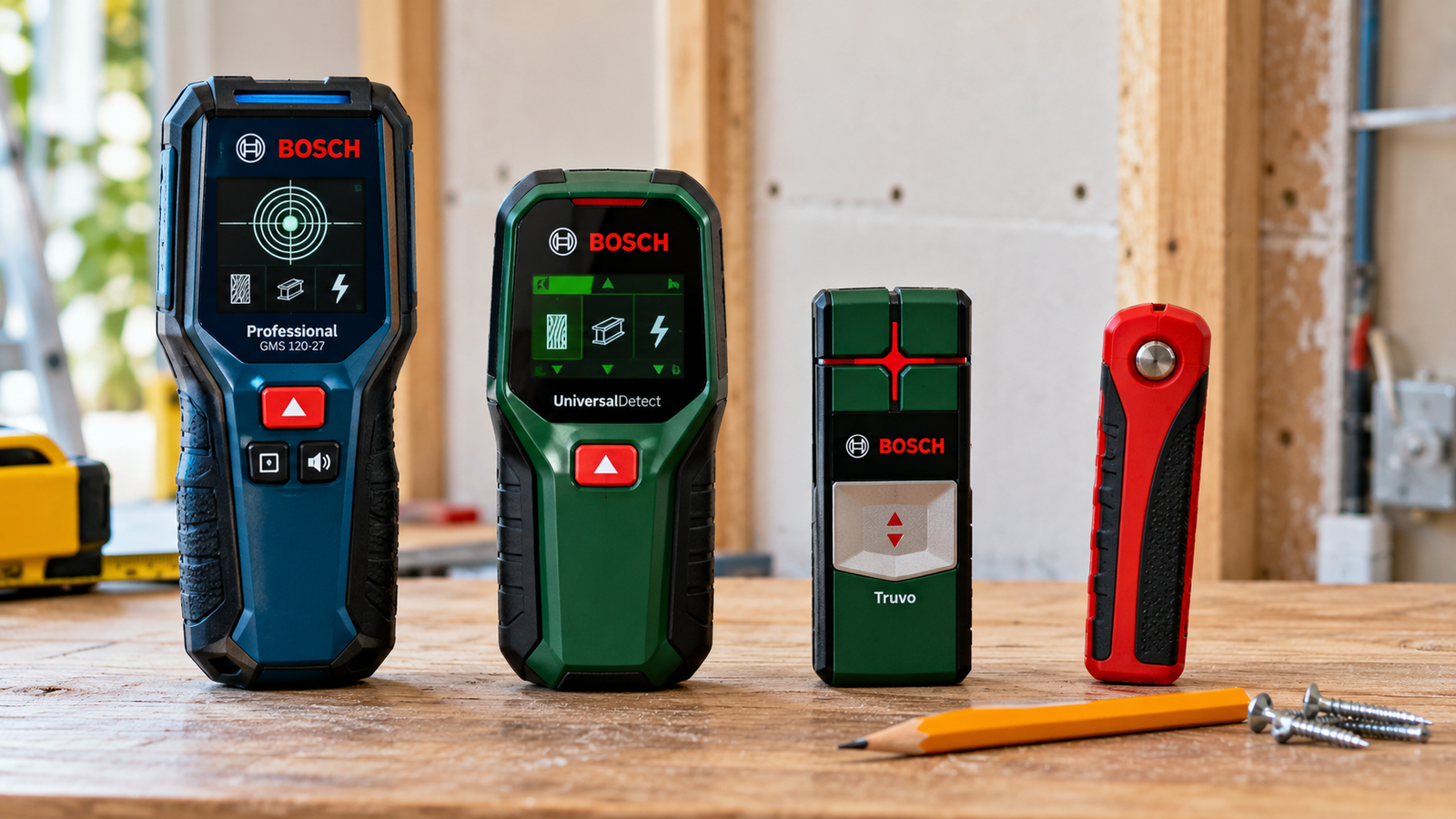
1. Bosch Professional GMS 120-27: Best Overall
The Bosch Professional GMS 120-27 is a strong choice for homeowners and tradespeople who want more than a simple timber detector. Bosch says it identifies magnetic metals, non-magnetic metals, wooden substructures in drywall, and live electrical cables.
Its stated maximum detection depths differ by material: up to 100 mm for magnetic metal, 120 mm for non-magnetic metal, 50 mm for live cables and 30 mm for wooden substructures. These are manufacturer specifications, not guarantees of performance in every wall.
The device also features material indicators, a center-finding function, and a marking hole. Its IP54-rated housing provides protection against dust and splashing water, making it suitable for demanding work environments.
Best for: Regular DIY, renovation projects and installations involving different concealed materials.
Main limitation: It costs more than a basic detector, and its timber-detection mode is intended for drywalls with wooden substructures.
2. Bosch UniversalDetect: Best for Occasional DIY
The Bosch UniversalDetect is worth considering if you want guided operation for everyday household jobs. It offers detection modes for wooden substructures, metal, and live electrical cables, with an on-screen interface designed to help users interpret results.
This makes it useful when mounting a small cabinet, installing shelving, or planning a straightforward home improvement project. A guided display may also be easier to understand than a basic device that communicates through sound alone.
However, having several detection modes doesn’t mean the tool can reliably identify every concealed object. Wall thickness, moisture, foil-backed insulation, and the material beneath the plasterboard can affect readings.
Best for: Homeowners who want a straightforward, guided detector for occasional jobs.
Main limitation: It is less suitable for demanding inspections where unusual construction or deeper concealed objects require more advanced equipment.
3. Bosch Truvo: Best for Simple Checks
The Bosch Truvo is a compact option for basic pre-drilling checks. Its main purpose is to detect metal objects and live electrical cables, not to locate timber studs directly.
That distinction matters. If you want to mount a heavy television on a timber-framed plasterboard wall, a detector without a dedicated wood mode may not provide the information you need.
For simpler tasks involving metalwork or checking for electrical cable indications, its one-button operation can be convenient. Before purchasing, check the specifications of the exact model available in your country because product generations and regional packages can differ.
Best for: Occasional household jobs where metal and live-wire indications are the main priority.
Main limitation: It cannot identify a timber stud simply because it detects other objects behind a wall.
4. Magnetic Stud Finder: Best Budget Option
A magnetic stud finder is a sensible alternative if you want a simple tool without batteries or electronic calibration.
It uses a magnet to locate ferromagnetic screws or nails that secure plasterboard to timber or metal framing. By finding several fixings in a vertical line, you can often determine where a stud is.
The tool is inexpensive, portable and straightforward to use. It can also be useful on some older walls where electronic detectors struggle with irregular plaster surfaces.
However, magnetic finders detect suitable metal fixings, not timber itself. They may not work well if the fixings are too deep, non-magnetic, or absent from the area being scanned. They also do not warn you about live electrical wiring or plumbing.
Best for: Budget-conscious DIYers working with walls that contain detectable metal fixings.
Main limitation: It provides no independent warning about electrical cables or pipes.
How to Choose the Best Stud Finder
Choose the best stud finder based on your wall type, what you need to locate, and the consequences of an incorrect reading.
Check the Wall Material
Plasterboard walls with timber framing are generally suitable for conventional stud detectors. Some models can also identify metal framing, which is common in certain modern partition systems.
Solid brick, stone and concrete walls are different. A tool designed primarily for detecting timber behind plasterboard may not work effectively on dense masonry. For these surfaces, look for a wall scanner specifically designed for the materials and objects involved.
Older properties may have lath-and-plaster walls, multiple plaster layers, or metal mesh. These construction details can make readings less predictable.
Compare Detection Modes and Depth
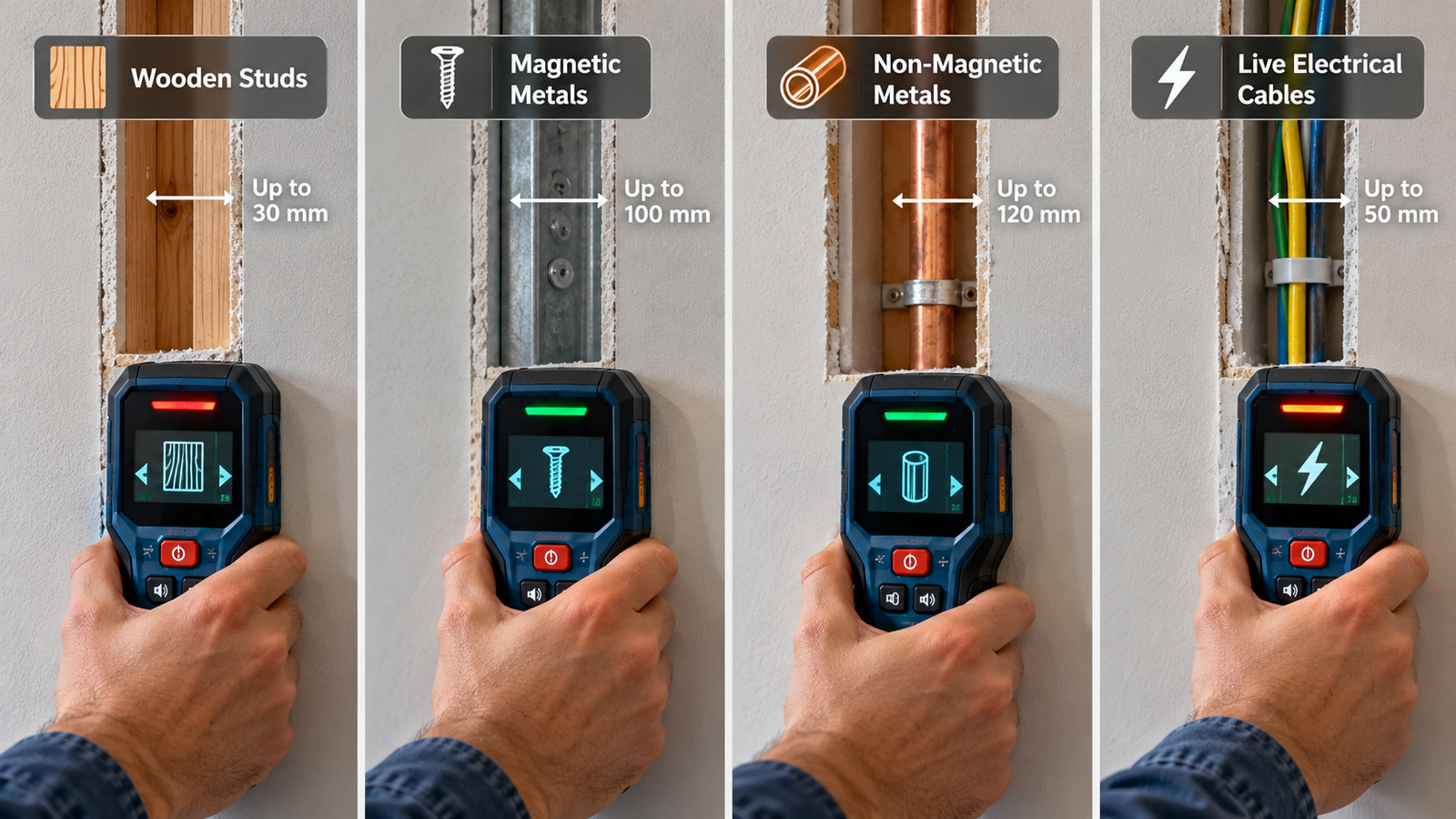
A headline detection depth can be misleading because manufacturers often specify different maximum depths for different materials.
Before choosing the best stud finder, check whether its specifications cover:
- Wooden studs behind dry plasterboard.
- Magnetic metals, including suitable steel fixings.
- Non-magnetic metals, such as copper.
- Live electrical cables under specified conditions.
- The particular wall material you intend to scan.
Do not assume that a detector can find plastic pipes simply because it is described as a wall scanner. Rely on plastic-pipe detection only when the manufacturer explicitly supports it for the relevant conditions.
Consider Ease of Use
Clear visual indicators, audible alerts, automatic calibration, and center-finding features can make scanning easier. A center-finding function is particularly useful when placing screws for shelves or brackets.
A magnetic detector may suffice for occasional lightweight tasks, but frequent renovation work may justify an electronic model with multiple detection modes.
Price should be considered alongside the tool’s capabilities, not as a substitute for them.
How to Use a Stud Finder Correctly
Even the best stud finder can give misleading readings if used incorrectly. Follow the instructions supplied with the specific device and use the following general approach.
- Prepare the area. Read the manual, check the wall surface, and identify nearby sockets, switches, taps, and radiators.
- Calibrate the detector. Place it against the wall and calibrate it as the manufacturer directs. Some devices require a clear area before scanning.
- Scan slowly. Move the tool steadily across the wall without lifting it unless the instructions tell you otherwise.
- Mark the results. Mark likely stud edges or centers and repeat the scan to see whether the readings are consistent.
- Check from another direction. Scan horizontally and vertically where appropriate to help distinguish framing from isolated metal objects.
- Assess the risk before drilling. Consider the likely route of electrical cables and plumbing, and do not treat a clear reading as proof that the wall is safe.
If the readings conflict, the wall contains unusual materials, or you suspect concealed services, stop and seek appropriate professional advice.
Important Safety Considerations Before Drilling
A detector is an aid to safer work, not a guarantee against damaging hidden services. Electronic cable detection can be affected by shielding, dampness, poor electrical contact, depth and the cable’s operating condition.
For example, Bosch warns that its GMS 120-27 may not reliably detect live cables where metallic foil, damp walls or other unfavourable conditions interfere with the signal. Its instructions explain these limitations in the official product documentation.
Never assume that a cable is absent because the detector gives no warning. Likewise, a basic stud finder is not a reliable method of locating every water pipe, gas pipe or concealed service.
Before drilling into a wall near electrical fittings, plumbing or heating equipment, consider the likely service routes and consult property plans where available. If a gas pipe may be present, do not proceed on the strength of a detector reading alone. Contact an appropriately qualified professional.
Renters should also check their tenancy agreement and obtain the necessary permission before making substantial alterations.
Which Stud Finder Should You Buy?
The best stud finder for most DIYers is the Bosch Professional GMS 120-27 because it combines multiple detection modes with material indicators and center-finding. Its advanced capabilities are especially useful when you need to detect multiple types of concealed objects.
The Bosch UniversalDetect is a reasonable alternative for occasional home projects, while the Bosch Truvo suits basic metal and live-wire checks. A magnetic finder can be the cheapest practical choice if you want to locate suitable metal fixings.
No single device works for every property. Match the device to your wall construction, read its limitations carefully, and use additional safety checks before drilling. For valuable installations or uncertain walls, a professional assessment is better than relying on a single consumer tool.
Frequently Asked Questions
What is the best stud finder for beginners?
The Bosch UniversalDetect is worth considering for beginners because its guided interface helps explain detection results. A magnetic finder is simpler and cheaper, but it detects only suitable metal fixings and doesn’t identify live electrical cables.
Can a stud finder detect electrical wires?
Some electronic models can indicate live electrical cables under specified conditions. Detection varies with cable depth, wall construction, shielding, and electrical conditions. A negative reading does not prove that drilling is safe.
Do stud finders work on brick walls?
Some wall scanners can detect metal and other concealed objects in masonry, but performance depends on the device and wall construction. A detector designed for timber studs behind plasterboard may be unsuitable for solid brick or stone.
Can a stud finder locate plastic water pipes?
Most basic stud finders cannot reliably detect ordinary plastic pipes. Certain advanced scanners support specific pipe-detection capabilities, but their effectiveness depends on the pipe contents, depth, and surrounding materials.
Is a magnetic stud finder accurate?
A magnetic finder can help locate screws or nails behind plasterboard when those fixings are within its effective range. It does not directly detect timber, and the result may be unreliable when suitable metal fixings are absent.
Should I drill after a stud finder shows a clear area?
No. A clear reading does not guarantee an area is free of electrical cables, water pipes, or other concealed services. Check the manufacturer’s limitations, assess likely service routes, and seek professional assistance when the risk is uncertain.






One Comment